America's Housing Affordability Crisis
Darrell Williams July 27, 2026
Darrell Williams July 27, 2026
If you've been renting, buying, or investing in real estate over the past decade, you've felt it: rents keep climbing, inventory stays tight, and "affordable" feels like a word from another era. But a new report suggests the housing affordability crisis isn't a permanent fixture of American life it's a solvable problem, and it could be fixed within a single generation.
The Housing Affordability Toolkit, released in June 2026 by the National Multifamily Housing Council (NMHC) in partnership with NYU's Schack Institute of Real Estate, lays out a roadmap for ending the crisis in roughly 17 years. Here's what the study found and what it means for renters, landlords, and investors in markets like New York City.
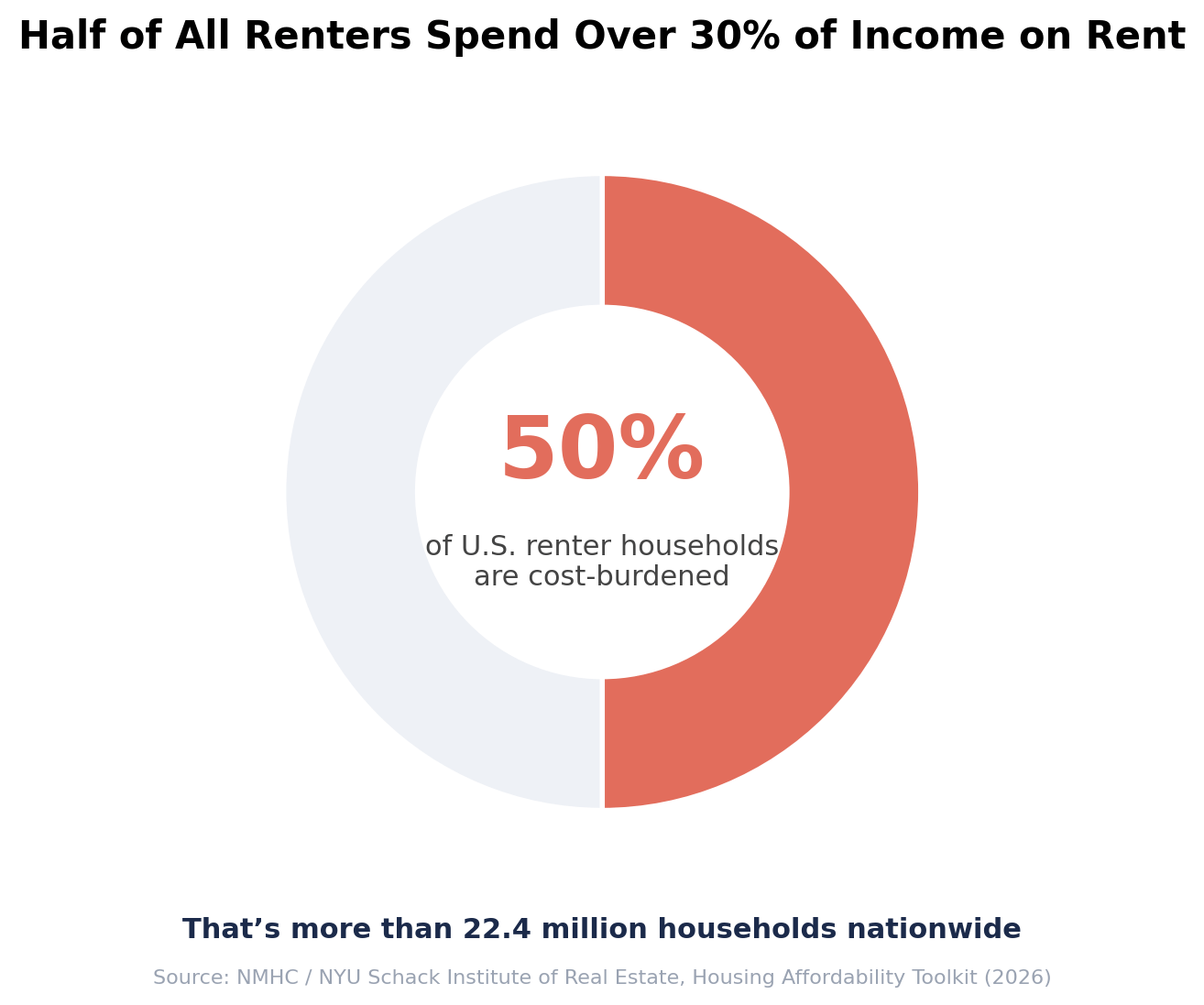
The numbers are sobering. More than 22.4 million U.S. renter households about half of all renters are considered cost-burdened, meaning they spend more than 30% of their income on rent. With renters making up roughly one-third of all American households, that's a crisis touching tens of millions of people.
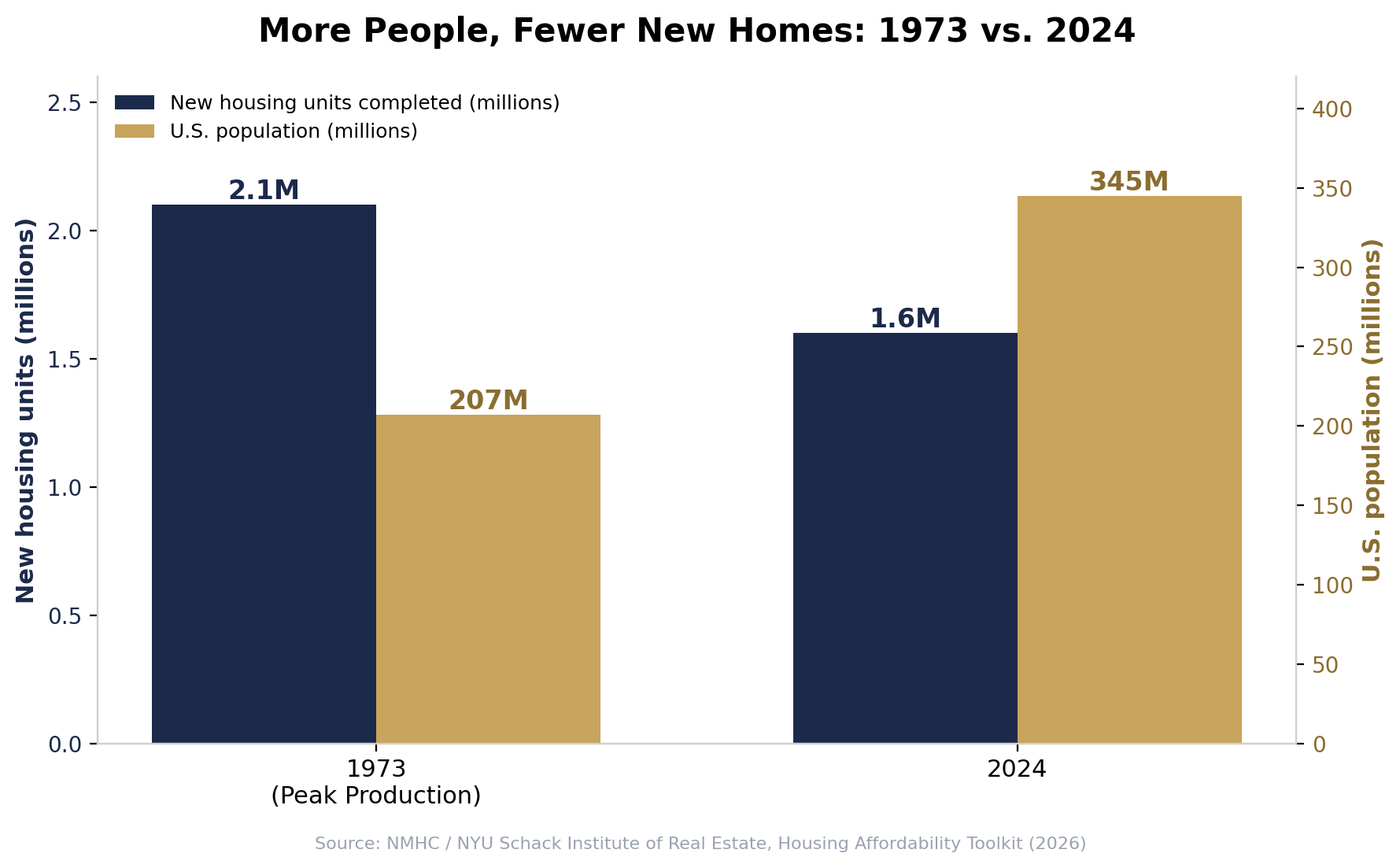
At its core, the problem is simple supply and demand. The last peak in U.S. residential construction came all the way back in 1973, when about 2.1 million units were completed for a national population of roughly 207 million. Fast forward to 2024: the population has grown to about 345 million, yet only 1.6 million new units came to market. Demand has exploded; supply hasn't kept pace.
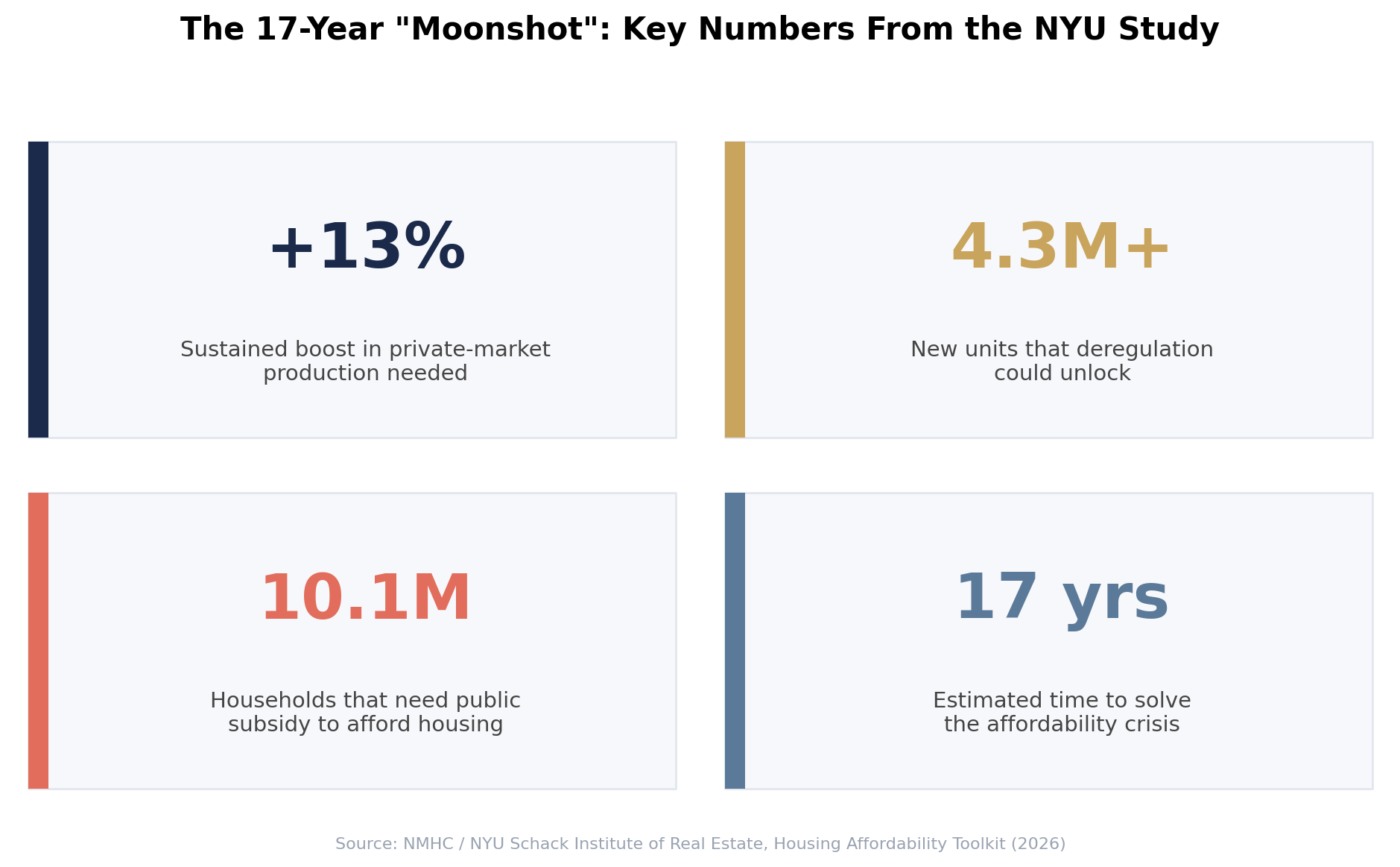
The study also makes an important distinction: there isn't one affordability crisis; there are two. The first is chronic undersupply in high-demand markets (hello, NYC), which pushes rent burdens up even for middle-class households. The second involves roughly 10.1 million extremely low-income households whose incomes will never cover the cost of producing housing, meaning no private-market solution can reach them without public subsidy.
The report compares solving the crisis to a moonshot ambitious, but achievable with sustained effort. The math behind it: a 13% increase in private-market housing production, maintained over time, would return the country to early-1970s output levels. Sustained for about 17 years, that pace could close the affordability gap.
The study recommends a three-pronged strategy:
According to the report, deregulation alone could unlock 4.3 million or more new housing units. Faster approvals and lower regulatory costs reduce the price of building, which increases competition and puts downward pressure on rents across the board.
Two tools stand out as the study's clear winners:
Tax abatements. Researchers found these deploy quickly, come with built-in public guardrails, and are already producing results in cities across the country. NMHC's research lead pointed to tax policy as the fastest lever local governments can pull to spur new supply.
Speedier approvals. NYU's Matthew Kwatinetz noted that time-to-approval is almost always the binding constraint on new development. Streamlining the process — including by-right approvals — gets shovels in the ground faster.
And the weakest tool in the kit? According to the study, it's rent regulation. Despite its political popularity, the researchers found that both economic theory and real-world results show it underperforms compared to policies that actually scale supply.
For New Yorkers, this study hits close to home. NYC is the poster child for chronic undersupply: intense demand, limited land, lengthy approval timelines, and layers of regulation. If policymakers adopt the report's recommendations, particularly tax abatements and faster approvals, we could see meaningful new supply over the next decade.
For renters, more supply eventually means more choices and slower rent growth. For landlords and investors, the takeaway is that policy momentum is shifting toward production incentives, which could open new opportunities for development, conversion, and preservation projects.
In the meantime, the market remains competitive. Whether you're leasing your first NYC apartment or leasing out an investment property, preparation and expert guidance are more valuable than ever.
Whether you're a renter navigating a competitive market, a landlord looking to lease your property, or an investor watching where housing policy is headed, having the right advisor makes all the difference. Contact me today for a free consultation. I'll help you get your paperwork in order, price your property right, and move quickly when opportunity strikes. Let's find your place in the city, together.
A renter is considered cost-burdened when they spend more than 30% of their gross income on rent. According to the NYU/NMHC study, more than 22.4 million U.S. renter households, or about half of all renters, fall into this category.
The study estimates roughly 17 years, about one generation, if the U.S. sustains a 13% increase in private-market housing production alongside expanded subsidies for the lowest-income households and meaningful local deregulation.
Because there are two separate crises. New construction can address chronic undersupply in expensive markets, but the study estimates about 10.1 million households earn too little to afford housing at any price the private market can produce. Serving those households requires public subsidies and rental assistance.
Tax abatements and faster, by-right project approvals scored highest, because they deploy quickly and scale well. Rent regulation scored lowest; the researchers found it performs poorly compared to supply-focused tools, despite its political appeal.
Darrell Williams is available for a private conversation. Schedule a Consultation to talk through it at your pace.
Sources: NMHC & NYU Schack Institute of Real Estate, "Housing Affordability Toolkit" (June 2026), as reported by Multi-Housing News.





Everything You Need to Know About This Flatiron Luxury Condo Conversion



10 Frauds & Red Flags
Can it be solved?
Darrell Williams works in Manhattan, Brooklyn, Queens, and the Bronx. His expertise includes new development sales/leasing projects, investment sales, and 1st time home buyers. Whether you're purchasing or selling, he'll keep you feeling comfortable and confident from start to end.

Darrell Williams
Compass Headquarters 110 5th Ave 3rd floor New York, NY 10011