Waiting for Lower Mortgage Rates?
July 24, 2026
July 24, 2026
If you're waiting on the sidelines for mortgage rates to fall before buying a home, you're not alone, but you might be making a costly mistake.
It's the real estate version of "The Monkey's Paw": you may get exactly what you wished for, and it may come with consequences you didn't see coming. If rates drop significantly, every other buyer who's been waiting rushes back into the market at the same time. More competition means bidding wars, fewer concessions, and rising prices that could wipe out any savings a lower rate would have delivered.
Here's what today's market actually looks like, and why the smartest buyers are focusing on strategy instead of timing.
After briefly touching a nine-month high above 6.5%, the average 30-year fixed mortgage rate has settled back into the mid-6% range. That number feels high to buyers who remember the pandemic-era lows of 2020 and 2021 but historically speaking, it's completely normal.
For most of the 1990s and early 2000s, mortgage rates hovered between 6% and 8%, and millions of Americans bought homes, built equity, and refinanced when opportunities arose. The 3% mortgage was the anomaly, not the baseline. Most housing economists agree that rates in the mid-6% range may simply be the new normal.
The real affordability challenge in 2026 isn't rates alone; it's the combination of rates, elevated home prices, rising insurance premiums, and property taxes. And that's exactly why strategy matters more than timing.
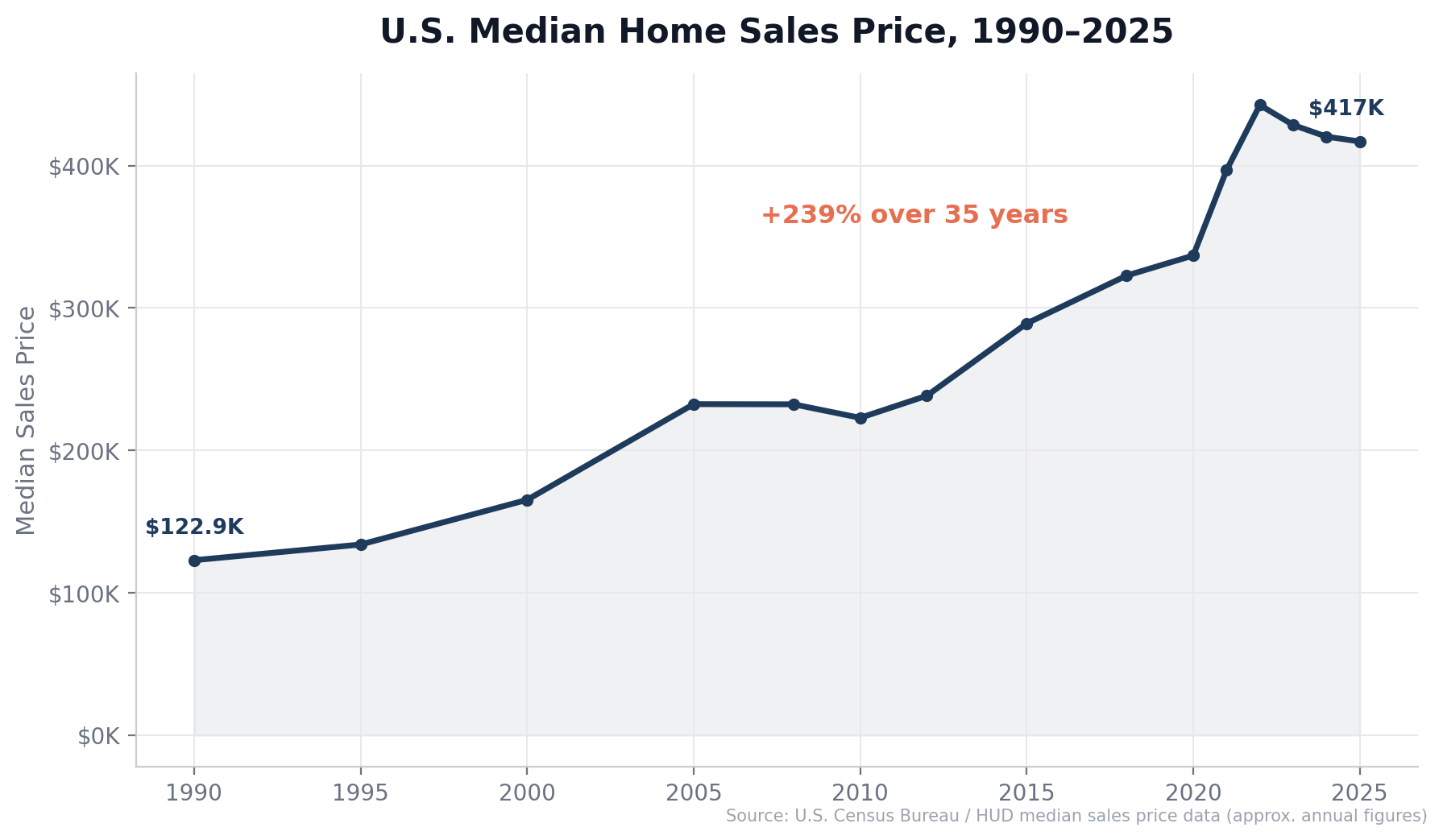
Buyers who wait for the "perfect" rate are betting against one of the most consistent trends in American real estate: over the long run, home values go up. The U.S. median home sales price has climbed from roughly $123,000 in 1990 to around $417,000 today, an increase of more than 230% across 35 years, through recessions, rate spikes, and even the 2008 housing crash.
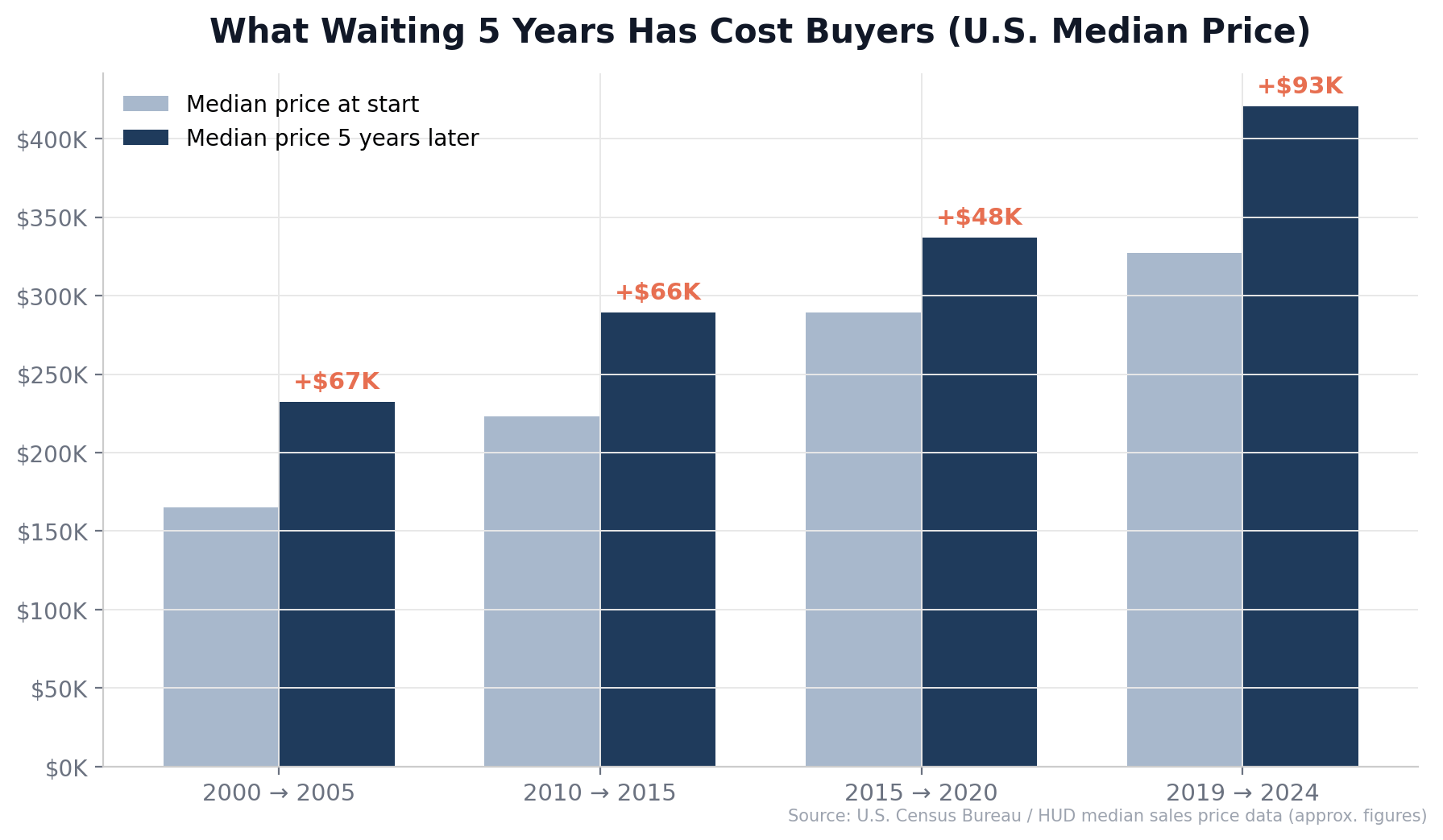
In each of these windows, buyers who purchased at the start built equity as prices climbed. Buyers who waited paid more often dramatically more and started their equity clock years later.
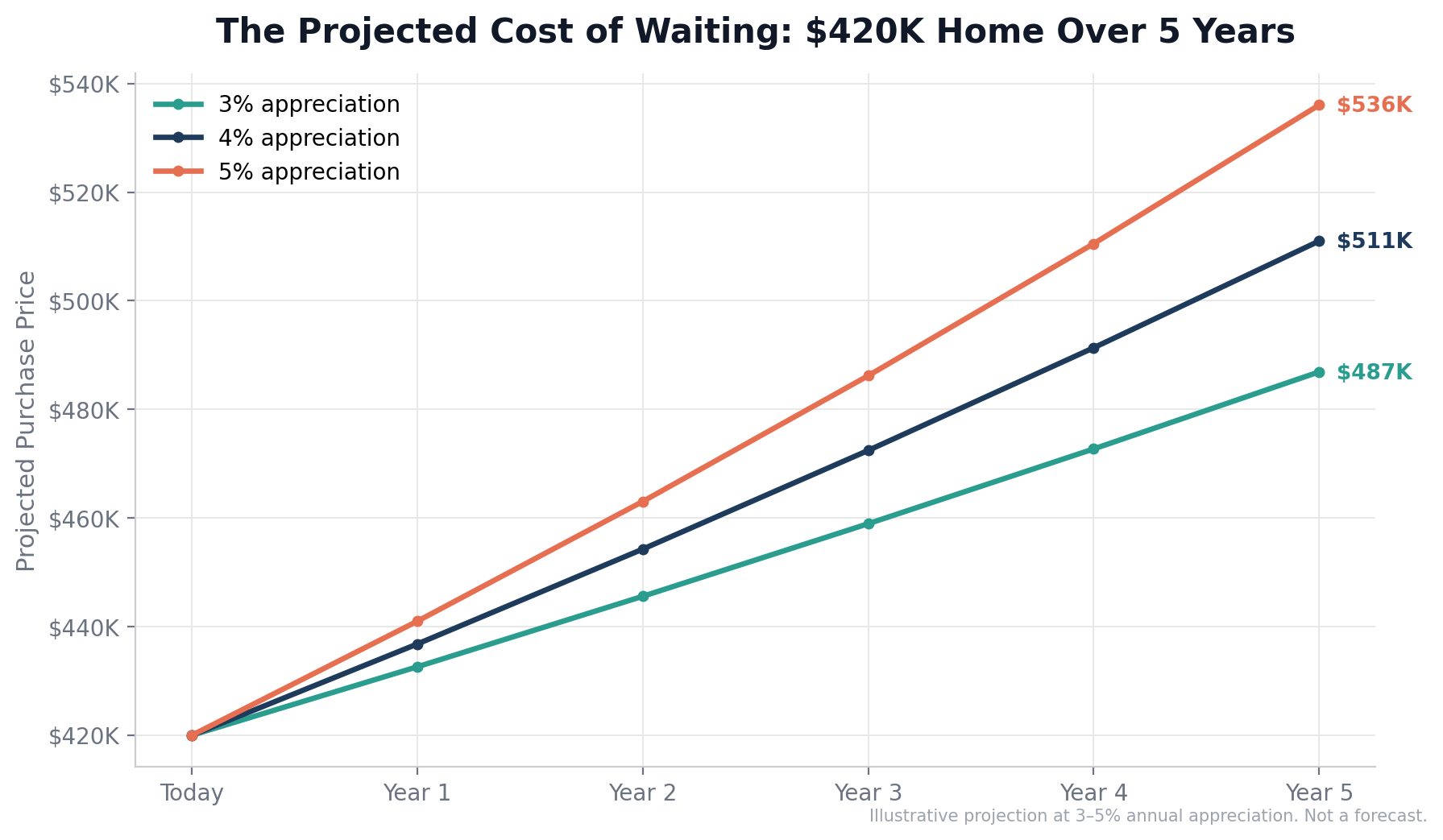
No one can predict prices with certainty, but even modest appreciation compounds quickly. Here's what a $420,000 home could cost over the next five years at historically typical appreciation rates of 3–5% per year:
At just 4% annual appreciation, today's $420,000 home costs about $511,000 in five years, a $91,000 premium for waiting. At 5%, the gap grows to over $116,000. Even a meaningfully lower interest rate rarely offsets that kind of price increase, especially once you factor in the larger down payment and the years of equity growth you gave up.
The takeaway: waiting doesn't pause the market. It usually just means buying the same home later, at a higher price, with more competition.
Yes, higher rates reduce purchasing power. On a $300,000 loan, the difference between a 4% and 6% interest rate is roughly $367 per month. That's real money.
But here's what the "wait for rates to drop" crowd often misses:
Today's buyers have leverage. Housing inventory is at its highest level since 2019, and listing prices have declined for several consecutive months. Sellers are negotiating. That means buyers can push for seller concessions, closing cost credits, rate buydowns, and price reductions that would be off the table in a hot market.
Lower rates bring back the competition. The moment rates fall meaningfully, sidelined buyers flood back in. Inventory tightens, bidding wars return, and home prices climb. The monthly payment you "saved" on interest can quickly be consumed by a higher purchase price —and you lose the negotiating power you have today.
You can refinance a rate. You can't refinance a purchase price. Buy at a fair price with strong concessions now, and if rates drop later, refinancing lets you capture the lower rate anyway. The buyer who waited gets neither the concessions nor the lower price.
Instead of waiting for a perfect rate that may never come, savvy buyers are using these tactics:
Negotiate a rate buydown. In a buyer-friendly market, many sellers and builders will pay to temporarily or permanently reduce your interest rate. A 2-1 buydown can meaningfully lower your payments during the first years of ownership.
Focus on the monthly payment, not the headline rate. Between seller concessions, buydowns, and negotiated pricing, your actual monthly cost may be far better than the sticker rate suggests.
Explore assumable mortgages. Some FHA and VA loans allow qualified buyers to assume the seller's existing lower-rate mortgage one of the most overlooked opportunities in today's market.
Use your leverage while it lasts. With income growth now beginning to outpace home price growth and more homes to choose from, buyers have more room to be selective and to negotiate than they've had in years.
The bottom line: there is rarely a "perfect" time to buy a home. Successful buyers focus less on timing the market and more on making today's market work in their favor.
Don't let market timing paralysis cost you the right home or the leverage you have right now. Whether you're a first-time buyer or planning your next move, I'll walk you through what today's rates really mean for your budget, which negotiation tactics are working in our market, and how to structure an offer that protects your bottom line.
📞 Schedule your free, no-obligation buyer consultation today and get a personalized game plan before the competition comes back. Contact Darrell Williams
FAQ
1. Should I wait for mortgage rates to drop before buying a house?
Not necessarily. While lower rates reduce your monthly payment, falling rates typically bring a surge of buyers back into the market, driving up competition and home prices. Historically, waiting has been expensive: the U.S. median home price rose roughly $93,000 between 2019 and 2024 alone. Buying now when inventory is high and sellers are negotiating may save you more overall, and you can always refinance if rates decline later.
2. Are mortgage rates in the 6% range historically high?
No. Rates between 6% and 8% were the norm throughout the 1990s and early 2000s. The ultra-low rates of 2020–2021 were a historical anomaly driven by extraordinary circumstances. Many economists believe mid-6% rates represent a return to normal rather than a temporary spike.
3. What is a rate buydown, and how does it help?
A rate buydown is when a seller, builder, or buyer pays an upfront fee to reduce the mortgage interest rate either temporarily (like a 2-1 buydown) or for the life of the loan. In today's buyer-friendly market, many sellers are willing to fund buydowns as a concession, lowering your monthly payment without waiting for the broader market to change.
4. How much more do I pay per month at a 6% rate versus 4%?
On a $300,000 loan, the difference is roughly $367 per month. However, that gap can often be narrowed or offset through seller concessions, negotiated purchase prices, buydowns, or assumable mortgage advantages that tend to disappear when rates fall and competition returns.
My name is Darrell Williams, a licensed Associate Real Estate Broker in New York City. I work with sellers, buyers, and investors throughout Manhattan, Brooklyn and Queens.
Schedule a Consultation and let's connect







Darrell Williams works in Manhattan, Brooklyn, Queens, and the Bronx. His expertise includes new development sales/leasing projects, investment sales, and 1st time home buyers. Whether you're purchasing or selling, he'll keep you feeling comfortable and confident from start to end.

Darrell Williams
Compass Headquarters 110 5th Ave 3rd floor New York, NY 10011