Buyer & Seller Education
New condo reserve rules start January 4, 2027
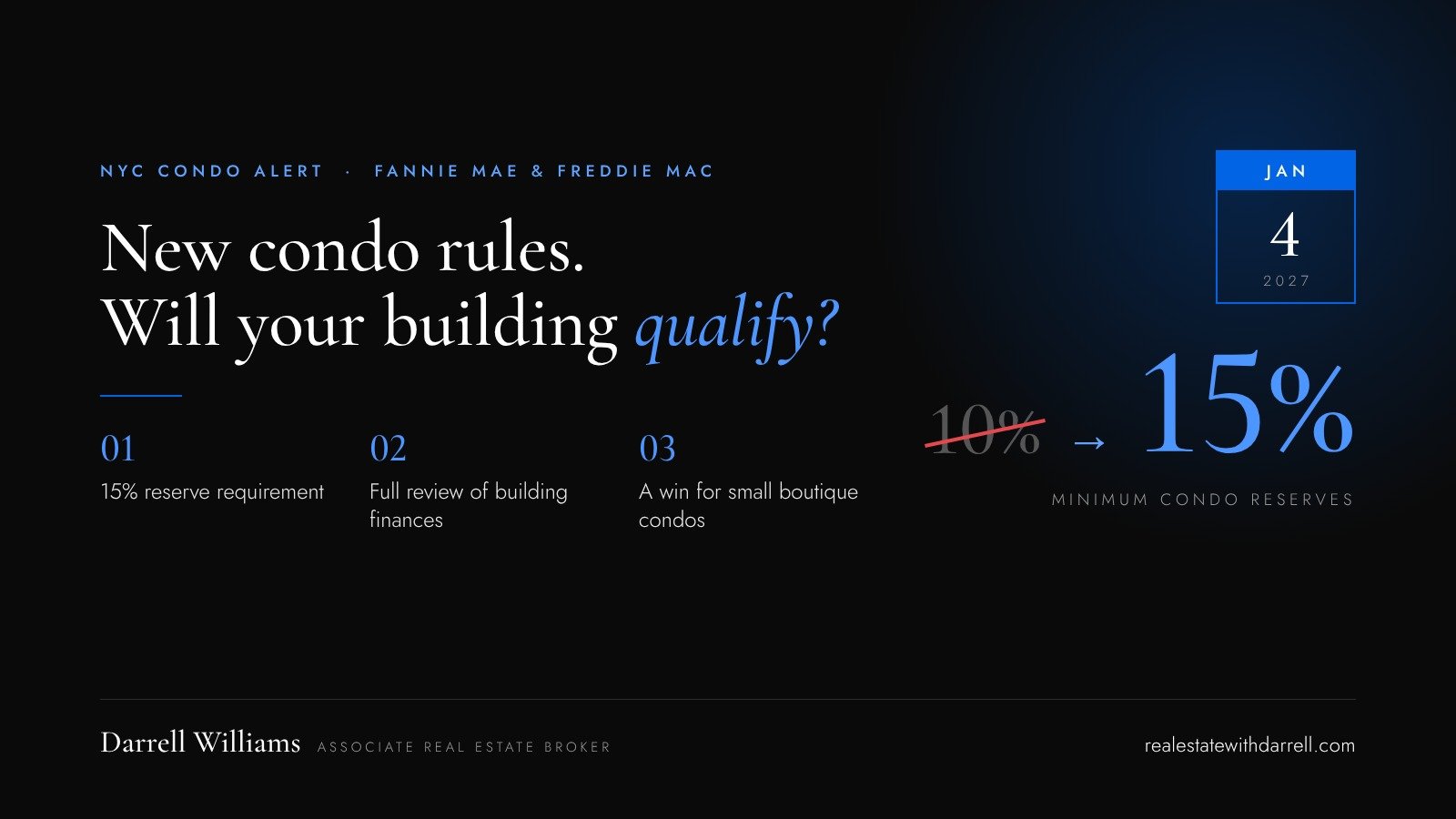
Starting January 4, 2027, Fannie Mae and Freddie Mac will require many condo associations to put at least 15% of their budget into reserves, up from 10%. The goal is financially healthier buildings. The practical effect is that some NYC condos that qualify for conventional financing today may not qualify tomorrow, while small boutique condos may find financing easier. Here's what's changing and what to do about it.
In this guide
- 01What's changing
- 02Why some buildings could lose financing
- 03What got easier
- 04What it means for buyers
- 05What sellers and boards should do now
01Lesson
What's changing for condo financing in 2027?
The reserve requirement rises from 10% to 15%. For a conventional loan backed by Fannie Mae or Freddie Mac, the condo association's budget must set aside at least 15% of its annual assessment income for replacement reserves, the money that pays for roofs, facades, elevators and other major repairs. The date that counts is the buyer's loan application, not the closing.
Key termReplacement reserves
Money an association sets aside every year for big future repairs. Lenders measure it as a share of the budget, not as the balance in the bank.
Example
Reserves needed on a $500,000 condo budget
Same building, same budget: the new rule asks for 50% more in yearly reserve contributions
Illustration only. The test is the share of the association's annual budgeted assessment income set aside for replacement reserves.
A building can also qualify with a reserve study instead, as long as the study is no more than three years old and the budget funds its highest recommended contribution.
02Lesson
Why could my building qualify today but not tomorrow?
Because more buildings now get a full look at their finances. The streamlined Limited Review ended on August 3, 2026, so almost every condo with more than 10 units now goes through a Full Review of its budget, reserves and insurance. A building that has been funding 10% will fall short once the 15% rule starts, unless the board adjusts the budget.
Lenders also look closely at how a building is running. In my experience, banks can have trouble approving a building that has posted operating losses two years in a row, or one running a deficit of more than 5% of its budget.
Rule | Before | Now or starting January 4, 2027 |
|---|---|---|
Reserve contribution | At least 10% of the budget | At least 15% of the budget (loan applications on or after January 4, 2027) |
Project review for buildings over 10 units | Many loans used Limited Review, with little financial analysis | Full Review of the budget, reserves and insurance (Limited Review ended August 3, 2026) |
Buildings with 10 or fewer units | Waiver only for 4 units or fewer | Waiver for 10 units or fewer; insurance still has to qualify |
Investor-owned units | 50% cap in established projects | Cap retired |
Reserve study option | Available | Must be 3 years old or less, with the budget funding its highest recommendation |
Sources: Fannie Mae Lender Letter LL-2026-03 and the Freddie Mac Seller/Servicer Guide.
03Lesson
Did anything get easier for condo buyers?
Yes, two things. First, the 50% cap on investor-owned units in established buildings is gone, so a condo with a lot of renters is no longer turned down for that reason alone.
Second, buildings with 10 or fewer units can now skip the project review. Lenders no longer need the building's financials or condo questionnaire, only proof that its insurance qualifies. That could help the many small condos in Brooklyn and some of Manhattan's higher-end boutique buildings, where conventional financing used to be harder.
Buying or selling a condo before or after January 4? Contact Darrell Williams to review the building first.
04Lesson
What could the new rules mean for buyers?
Mostly more paperwork and more questions about the building. Here's what to expect:
- Fewer conventional loan optionsSome buildings may no longer qualify for Fannie Mae or Freddie Mac financing.
- More project reviewLenders will ask for budgets, reserve figures and insurance details on more buildings.
- Possible delaysA building review can add time during underwriting, so build it into your contract timeline.
- Higher common chargesAssociations raising reserve contributions often pass the cost on to owners.
- Closer look at building financesExpect your lender, and your attorney, to dig deeper into the budget.
- Fewer qualified buyers for some homesIf a building doesn't qualify, its buyers may need a different loan type or more cash.
05Lesson
What should condo sellers and boards do now?
Check the budget before January 4. If you're thinking about selling, ask the managing agent what share of the budget goes to reserves and whether the building ran a deficit in the last two years. If the answer is below 15%, ask whether the board plans to raise contributions or commission a reserve study. Knowing before you list keeps a buyer's financing from falling apart mid-deal, and a building that clearly qualifies is easier to sell.
Questions
Frequently asked questions
What are the new condo reserve rules for NYC buyers in 2027?
Starting with conventional loan applications dated January 4, 2027, Fannie Mae and Freddie Mac will require an NYC condo's budget to put at least 15% of its annual common charge income toward replacement reserves, up from 10%. If a Manhattan or Brooklyn condo falls short, buyers may not be able to get a conventional loan there.
Will my NYC condo still qualify for conventional financing after January 4, 2027?
It depends on the building's budget. Ask the managing agent what share of the budget goes to reserves. At 15% or more, or with a recent reserve study the budget fully funds, the building should meet the new standard. Below 15%, the board may need to raise reserve contributions.
Will common charges go up in NYC condos because of the new rules?
They may. Condo boards in Manhattan, Brooklyn and Queens that fund reserves below 15% will need to raise contributions, cut other costs or commission a reserve study, and higher common charges are a common way to close the gap.
Do the new rules help small boutique condos in Brooklyn and Manhattan?
Yes. Condo buildings with 10 or fewer units can now use a waiver of project review, so lenders don't need the building's financials or condo questionnaire, only proof that the insurance qualifies. That helps many small Brooklyn condos and boutique Manhattan buildings.
Can I get a conventional loan in an NYC condo with a lot of investor owners?
Yes. The 50% cap on investor-owned units in established condo buildings has been retired, so an NYC condo with many rented units is no longer turned down for that reason alone.
Do the 2027 reserve rules apply to NYC co-ops?
This update covers condominiums. NYC co-op purchases go through their own lender review and board approval, so ask your lender how they evaluate the co-op's finances.
How should I check an NYC condo's finances before signing a contract?
Have your attorney review the building's budget, financial statements and reserve contributions during due diligence, and confirm with your lender that the building qualifies. Contact Darrell Williams for help reviewing a Manhattan or Brooklyn condo.
This article is general information, not lending or legal advice. Lenders may apply their own additional requirements. Talk with your lender and attorney about a specific building.
Buying or selling a condo in New York City? Contact Darrell Williams for a private consultation, or view my Compass profile and listings.